By Laraba Usman
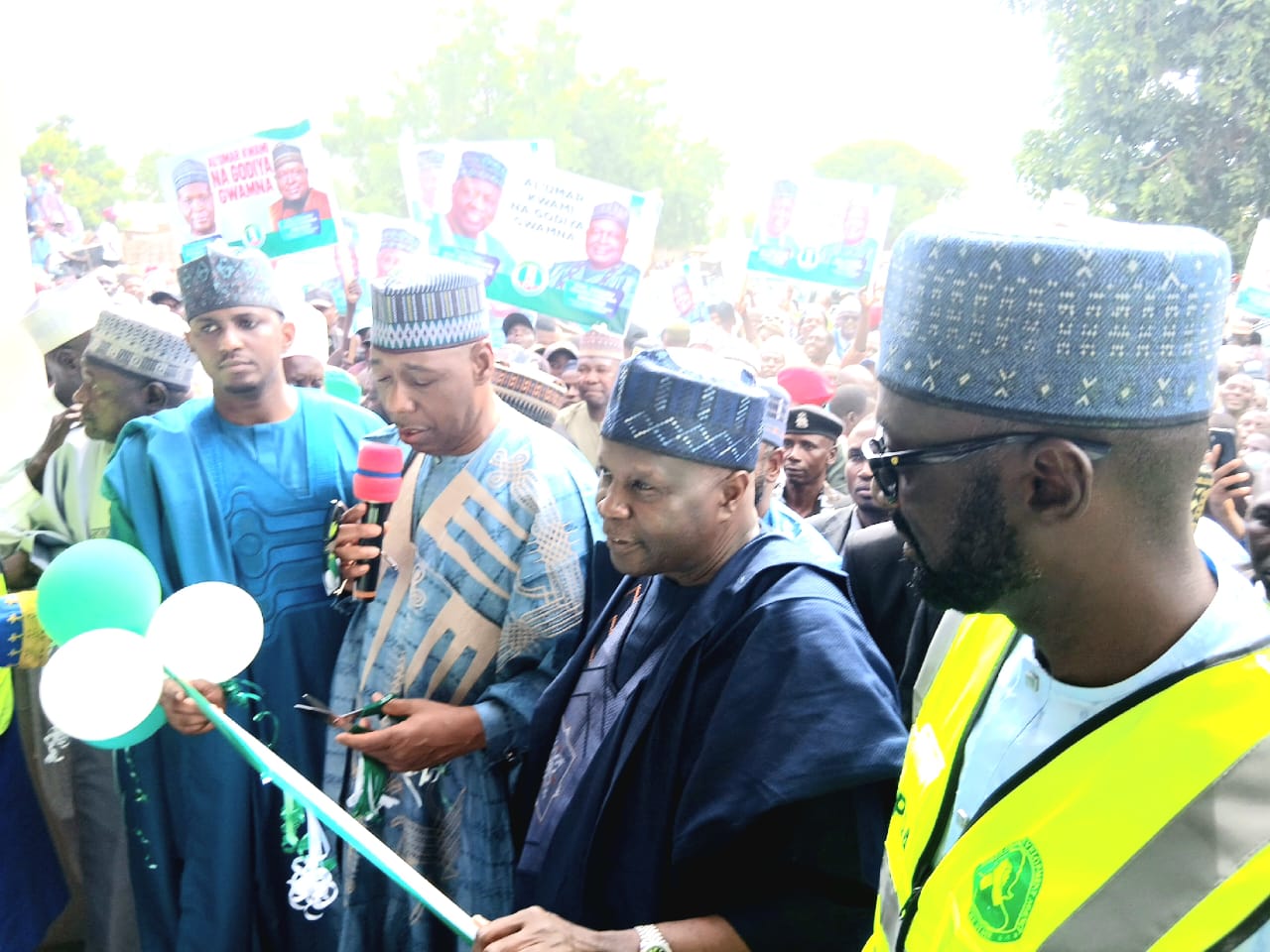
The Governor of Borno State, Prof. Babagana Umara Zulum, has inaugurated over 86 kilometres of newly completed roads and a three-span bridge in Gombe State, describing the projects as a major boost to rural connectivity, agriculture and economic development.
The projects, delivered by the administration of Governor Inuwa Yahaya under the Network-1100 road programme, were inaugurated during Governor Zulum’s visit to the state.
Among the projects inaugurated was the 41-kilometre Shango-Sarkin Yaki-Abuja/Bula-Bomala-Dinawa-Alagarno-Kalajanga-Tappi Road in Kwami Local Government Area.
The road connects several communities along the Gombe-Tappi corridor and terminates at Tappi on the Gombe-Kano Highway. Its completion is expected to ease movement between Gombe metropolis and surrounding rural communities, while providing better access to farmlands, markets and other economic opportunities.
Also inaugurated were the 30-kilometre Kwanan Gerkwami-Tsangayari-Gerkwami-Daniya-Daban Fulani Road, the 15-kilometre Kurba-Titi-Tsangayari Road with a spur to Kundulum, and the three-span Titi-Kurba Bridge.
Speaking at the commissioning ceremonies, Governor Zulum commended Governor Inuwa Yahaya for what he described as an impressive transformation of Gombe State through sustained investment in infrastructure.
He said the newly inaugurated projects would strengthen rural economies, stimulate agricultural production and improve the livelihoods of residents by connecting communities to markets and other economic centres.
“Construction of roads connecting cities to rural communities will no doubt expand farming opportunities, thereby enhancing the means of livelihood of the community,” Zulum said.
The Borno Governor described the level of infrastructure development witnessed in Gombe under the present administration as unprecedented in the history of the state.
“I want to use this platform to commend His Excellency, Governor Inuwa Yahaya, for all the good works that he has been doing in Gombe. Such kind of development is unprecedented in the history of Gombe State,” he said.
Zulum said he was particularly impressed by the scale of development achieved by the Inuwa Yahaya administration, noting that he had personally witnessed the impact of the projects across the state.
“Honestly, I did not know that Gombe had witnessed this level of development under the present administration. Governor Inuwa Yahaya is a Governor known and respected for his uncommon performance, and I am pleased to have come to Gombe and witnessed these remarkable achievements for myself,” he said.
He urged the people of Gombe to continue supporting the state government in its efforts to transform the state.
“I must say that the people of Gombe are indeed fortunate to have a Governor who is so committed to their development. I therefore urge the people to reciprocate this selfless service by supporting and appreciating the Governor’s efforts to transform the state,” Zulum added.
In his remarks, Governor Inuwa Yahaya said the newly inaugurated roads and bridge were strategically constructed to link communities, improve mobility and unlock the economic potential of areas along the various corridors.
He explained that the projects formed part of his administration’s sustained investment in critical infrastructure designed to connect communities, expand economic opportunities and improve the quality of life of residents.
According to him, the projects are being executed under the Network-1100 programme, which targets the construction of approximately 1,100 kilometres of roads across Gombe State’s 11 Local Government Areas.
Governor Inuwa Yahaya said his administration had, as it entered the final phase of its tenure, constructed more than 1,000 kilometres of roads, representing a significant milestone in the state’s infrastructure development programme.
He added that the expanded road network would facilitate the movement of people and agricultural produce, improve access to markets and essential services, and stimulate economic activities across the state.