By Abubakar Rabilu Gombe
The Chairman of the Gombe State Civil Service Commission (CSC), Hajiya Rabi Shuaibu Jimeta, has urged women to rise, demand their rights and unite to secure greater representation in governance, saying meaningful progress cannot be achieved without collective action and mutual support.
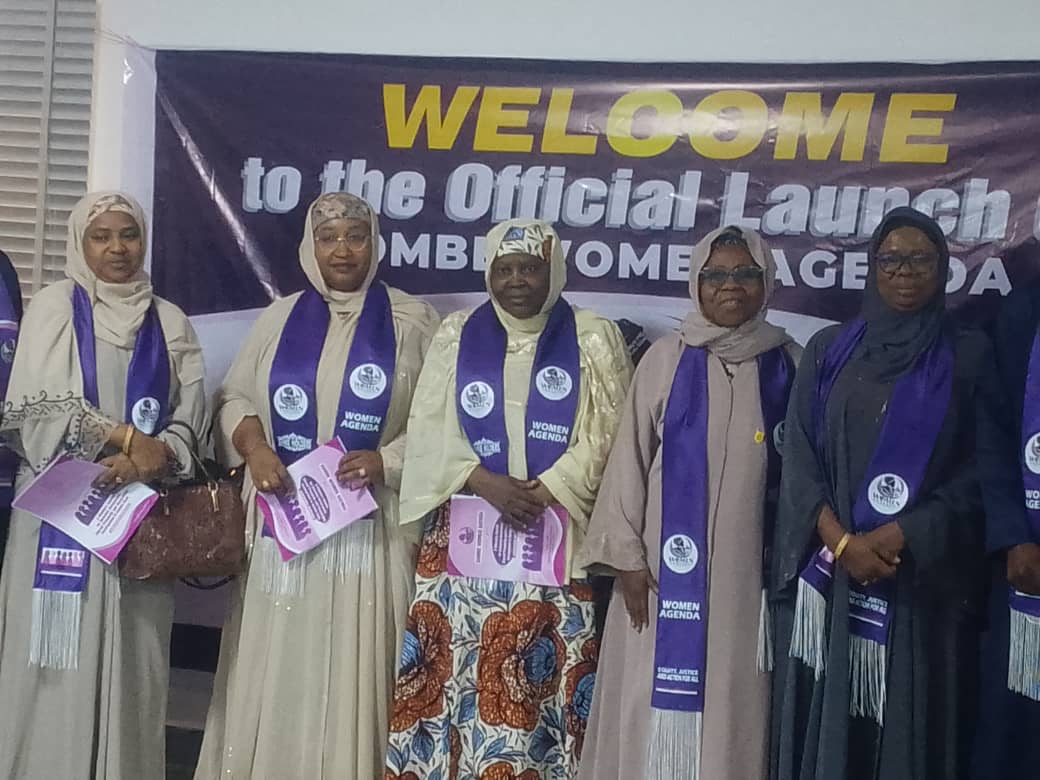
She made the call during the official launch of the Gombe Women Agenda 2027–2031, where she described the initiative as an important platform for promoting inclusive governance, women’s empowerment and accountability.
Jimeta said women must move beyond individual interests, organise themselves and actively participate in decision-making processes to ensure their voices are reflected in government policies and programmes.
Recounting her experience, she said she was among the few girls who attended primary school in the early 1960s when female education was discouraged in some communities.
She said her father insisted on sending his daughters to school despite opposition from neighbours, an opportunity that shaped her life and inspired her advocacy for women’s advancement.
She recalled serving at state and federal levels before retiring as a Federal Permanent Secretary, stressing that women who had benefited from opportunities had a responsibility to empower younger generations.
“The advancement of Gombe State cannot be complete without the meaningful participation, contributions and leadership of women,” she said.
She acknowledged the opportunities provided to women by the present administration, including the appointment of a female Chief Judge, three female commissioners, a woman heading the State Internal Revenue Service and a female Chairman of the Teachers Service Commission.
She urged political parties and candidates contesting the 2027 general elections to make concrete commitments towards women’s advancement and ensure that promises were translated into measurable results.
In her remarks, the President of the Gombe Women Agenda Movement, Zariyatu Abubakar Hashidu, said the agenda was developed to strengthen women’s participation in governance, promote inclusive development and improve accountability in the state.
She explained that the document was informed by the experiences and concerns of women across the 11 local government areas, covering issues such as political representation, education, economic empowerment, healthcare, gender-based violence, peacebuilding and social inclusion.
Hashidu said the agenda was organised around 10 strategic pillars and supported by a Charter of Policy Commitments, the Gombe Women Governance Compact and an Accountability Framework to monitor progress beyond electoral promises.
She emphasised that the agenda was non-partisan and not an endorsement of any political party or candidate, but a citizens’ accountability instrument designed to sustain engagement with political actors and public institutions throughout the 2027–2031 period.
Also speaking, the Gombe State Coordinator of the Adolescent Girls Initiative for Learning and Empowerment (AGILE), Dr Amina Haruna Abdul, urged women to take ownership of the agenda to sustain girls’ education beyond the lifespan of intervention programmes.
She said AGILE had increased female school enrolment, with many out-of-school children returning to classrooms through scholarships and other interventions.
However, she expressed concern about what would happen to beneficiaries when the programme ended and scholarship support was withdrawn.
“Our fear is what will happen to these children after AGILE. When the scholarships are no longer available, what will happen to them? I believe this agenda will fill that gap if we collectively accept and implement it,” she said.
Dr Amina also commended civil society organisations, particularly WILDAN, for supporting the Second Chance Education programme, which helps return out-of-school girls and young women to learning centres and formal schools.
Meanwhile, the Chief Judge of Gombe State, Justice Halima Shamaki Muhammad, called for practical and enforceable laws to protect women, girls and children.
She cautioned against imprisoning children whose involvement in crime resulted from poverty, neglect and lack of parental care, urging authorities to address the underlying causes rather than treat vulnerable children simply as offenders.
The Chief Judge also advocated stronger legal provisions against rape and indecent assault, noting that boys, as well as women and girls, were victims of sexual abuse.
She stressed that laws must reflect Nigeria’s social and economic realities and be supported by the necessary structures for effective implementation.
The speakers agreed that the success of the Gombe Women Agenda would depend on collective ownership, sustained advocacy and the commitment of government and other stakeholders to translating its objectives into tangible improvements in the lives of women and girls.