

By: Sanusi Dambatta, Kano
It has been observed that for decades, Nigeria’s agricultural mechanization efforts have been undermined by the absence of a clear, evidence-based policy and operational framework for establishing and managing Agricultural Mechanization Centre’s (AMCs).
This gap has contributed to the monumental failure of successive mechanization interventions, including large-scale tractor procurement programs by federal and state governments that lacked sustainable deployment, maintenance, and cost-recovery systems.
As a result, thousands of machines across the country have fallen into disrepair, while Nigerian farmers continue to bear the consequences through high production costs, delayed farm operations, low productivity, and persistent drudgery.
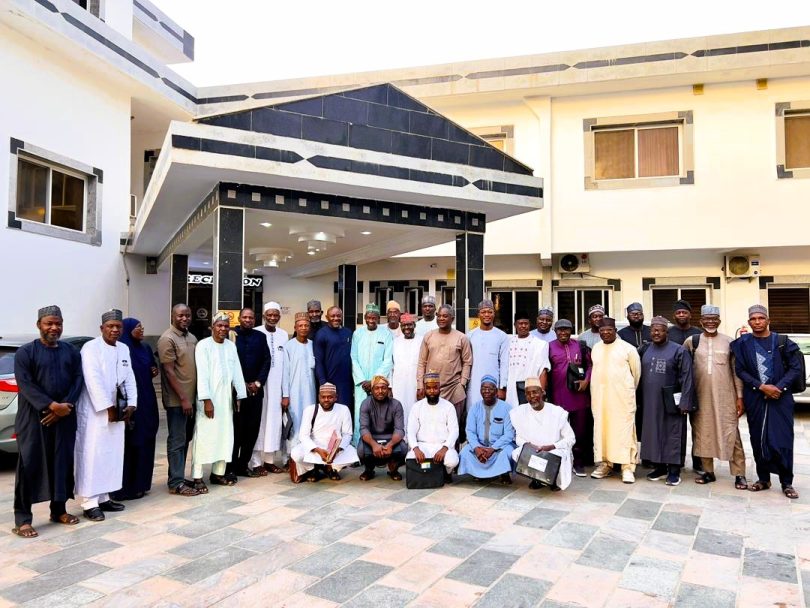
It is against this backdrop that the Sasakawa Africa Association (SAA) as the technical partner on the recently concluded Kano State Agricultural Development Projects (KSADP), convened Agricultural Mechanization Summit on the theme “Learning from Experience to Build Sustainable Agricultural Mechanization Centre’s in Kano State.”
The summit brought together key stakeholders from both public and private sectors including representatives of the States Ministry of Agriculture and Natural Resources, the Kano State Agropastoral Development Project (KSADP) leadership, the Kano State Agricultural and Rural Development Authority (KNARDA), academic institutions, Mechanization services providers, development partners, and farmer organizations among others to deliberate and chart a sustainable, commercially viable pathway for three (3) Agricultural Mechanization Centre’s established by SAA with funding from the KSADP Project in Kano State.
The forum provided a strategic platform to address critical questions regarding the future of the Centre’s including: How should these Centre’s be managed to ensure efficiency and accountability? What business models will make them financially viable? What roles should government, private operators, technical partners and farmer organizations (FOs) play? And how do we ensure that farmers remain at the Centre of sustainable service delivery?
Nigeria’s mechanization challenges remain stark.
With an estimated average of less than 0.3 horsepower per hectare, far below the Food and Agriculture Organization’s recommended benchmark of 1.5 horsepower per hectare, agriculture remains heavily dependent on manual labor.
In Kano State, where millions of smallholder farmers produce cereals, legumes, and horticultural crops for both local consumption and national markets, inadequate access to structured mechanization continues to constrain productivity, delay planting and harvesting, and exacerbate post-harvest losses.
Within this context, SAA’s engagement in Kano State reflects a practical experience-driven response since 2021.
Through its strategic technical implementation of the crop value chain on the KSADP Project, SAA identified the critical need for reliable, timely, and affordable mechanization services, an insight that directly led to the establishment of three (3) Agricultural Mechanization Centre’s under the project.
The Centres are strategically sited across the three agricultural zones, Central, North and South of Kano State, they were conceived not merely as infrastructure investments, but as pilot platforms for refining a sustainable and commercially viable mechanization service model.
Designed to respond to diverse farming systems and cropping calendars, the AMCs are intended to evolve into replicable and, scalable models, offering a sustainable solution to the persistent challenges of mechanization service delivery in Nigeria.
Participants at the summit reviewed past mechanization interventions and agreed that the absence of clear national and sub-national policy guidance, literature, and standardized operational models for AMCs has been a central cause of failure.
Fully government-owned and operated Centre’s have consistently struggled due to weak governance, poor maintenance, unclear accountability, revenue leakages, and political interference, rendering many well-intentioned public investments ineffective.
The summit emphasized that functional AMCs must operate as professionally managed service enterprises rather than as politically driven assets.
When properly structured, AMCs can significantly reduce turnaround time for land preparation, improve the timeliness of critical farm operations, lower production costs, and expand access to mechanization services for smallholder farmers who cannot afford to own machinery.
Speaking at the summit, the Country Director of Sasakawa Africa Association, Dr. Godwin Atser, underscored the need to rethink mechanization delivery in Nigeria.
“Procurement is not impact. Impact comes from how machinery is managed, maintained, and deployed to serve farmers efficiently and affordably over time,” he said.
“Without clear operational models and accountability systems, we will continue to repeat the mistakes of the past.”
Stakeholders unanimously agreed on the adoption of a private sector–led or Public–Private Partnership (PPP) model, with government providing policy oversight and an enabling environment.
The proposed framework prioritizes strong governance structures, transparent cost-recovery mechanisms, preventive maintenance and asset replacement planning, and digital payment systems to enhance accountability and reduce revenue losses.
The summit also highlighted the importance of inclusive access for smallholder farmers, who account for the bulk of agricultural production in Kano State.
Participants resolved that a structured, time-bound subsidy framework, ranging between 10 and 20 percent of prevailing market rates, should be introduced during the early years of AMC operations, with special consideration for women, youth, and farmer cooperatives.
Representing the Kano State Government, Dr. Farouk Kurawa, Managing Director of KNARDA, reaffirmed the state’s commitment to mechanization as a driver of agricultural transformation.
“Improving productivity, reducing drudgery, and strengthening market linkages are central to the Kano state agricultural agenda. Mechanization, when properly structured and professionally managed, is key to achieving these outcomes,” he noted.
Under the agreed framework, Sasakawa Africa Association will remain the technical partner to the mechanization Centre’s, supporting capacity building, performance monitoring, and systems strengthening.
Managed Service Providers (MSPs) will be competitively selected to manage day-to-day operations, inject operating and capital investment, and submit regular financial and operational reports to both government and SAA.
Beyond Kano State, the summit contributes to Nigeria’s growing body of knowledge on agricultural mechanization by documenting implementation lessons and defining a replicable AMC model.
The outcomes are expected to inform future policy formulation, guide public investment decisions, and support states seeking to transition from short-lived tractor distribution schemes to sustainable, service-based mechanization systems.
The summit concluded with a mandate for SAA to finalize the AMC operational model and develop a detailed implementation roadmap in collaboration with state authorities and partners.
By addressing long-standing policy and operational gaps, and by promoting professional management, structured subsidies, digital accountability systems, and strong legal backing, Sasakawa Africa Association reaffirmed its commitment to advancing a sustainable, inclusive, and performance-driven mechanization system, one capable of delivering lasting benefits to farmers in Kano State and contributing meaningfully to Nigeria’s broader agricultural transformation agenda.




Leave a Comment