

By: Adelowo Oladipo, Minna
Across the Country, many State Governors are boosting state economies with the view to attract multi-million dollar investments in this report, Adelowo Oladipo writes on how Governor Mohammed Umar Bago plans to create jobs, lights up Niger and power local businesses using solar energy.
It should be recalled that recently, the Federal government and Niger state government launched Nigeria’s biggest solar-powered industrial park, marking major shift towards clean industrial energy.
By partnering with federal agencies and the Private sector stakeholders/(organized private sector), Niger state under the Governor Mohammed Umar Bago- led administration is building solar-powered industrial parks with rural mini-grids, and panel manufacturing plants that will guarantee reliable electricity across the 25 Local Govt Areas of the state.
While commending Governor Bago for what he described as industrial Statesmanship, the Minister of Power, Engnr. Joseph Tegbe said the allocation of 500 hectares of land to the company would drive unprecedented economic development in Niger State and leave a lasting legacy by attracting massive investments into the state.
Tegbe described the land allocation as an act of “industrial statesmanship”, stressing that it demonstrated the state’s commitment to attracting private investment and creating lasting economic opportunities.
“The most enduring legacy of governance is not limited to physical infrastructure but includes the industries, investments and jobs created through strategic decisions”.
While handing over the land during the ground breaking ceremony at Diko in Gurara Local Government Area of the State, Governor Bago described the initiative as the beginning of a landmark project that would reshape the industrial landscape and expand opportunities for the people of Niger State.
According to him “what we are witnessing is more than a ceremony, rather, it is a clear declaration of our unwavering commitment to transforming Niger State into a leading investment destination of choice for sustainable economic growth. saying,it is an indication that our vision of building a “New Niger” is not only a promise, but it’s steadily becoming a reality.
He emphasized that “this is going to open up industrialisation here, taking advantage of our gas resources from the AKK pipeline, as well as our vast land for the development of solar power. Niger State hosts four hydropower dams,namely: — Kainji, Jebba, Zungeru and Shiroro. That, in addition, is one of the advantages we have.”
To also underscore the state’s commitment to the industrial development, Governor Bago revealed that the State government will declare and gazette 200,000 hectares of land from Dikko community to Tafa LGA, on the axis bordering Kaduna State for the establishment of industries.
Given the magnitude and importance of the project, the Federal Executive Council (FEC) has approved a $160 million financing package for the Niger State Solar Energy Development Project, a landmark initiative designed to expand electricity access and accelerate Nigeria’s renewable energy drive.
The financing arrangement comprises a $150 million facility from the Islamic Development Bank (IsDB) and $10 million in counterpart funding from the Niger State Government.
The project will deliver a 100-megawatt solar power plant in Niger State, significantly boosting electricity supply, particularly in rural communities.
Governor Bago, declared that it is expected to enhance power reliability, diversify Nigeria’s energy mix, and support agriculture, agro-processing, industrialisation, and climate change mitigation efforts.
Approval of the financing package follows months of collaboration between the Niger State Government and the IsDB.
In January 2026, Governor Umar Bago hosted the IsDB project preparation team for the Niger Solar Electrification Project (NGA1063), during which feasibility studies, environmental reviews, and social impact assessments commenced.
It should be noted that the Niger State Government under Governor Bago,-led administration had enhanced the deployment of solar mini-grids and other renewable energy solutions where over 180 communities that had endured over a decade without meaningful electricity supply are now enjoying 24-hour solar power in Niger State.
The initiative, described as a major breakthrough in ending years of prolonged blackout across parts of the state.
Beyond rural communities, it was gathered the state government has also transitioned key public institutions, including Government House, the General Hospital, the IBB Specialist Hospital, the Niger State Water Board, and several ministries, departments and agencies, to independent solar systems.
The project, spearheaded by Abuja Steel Mills Limited, a subsidiary of the African Industries Group, will be powered by a dedicated 200-megawatt solar mini-grid designed to supply electricity to a sprawling industrial park and integrated steel manufacturing complex in Niger State.
Unlike traditional manufacturing facilities that depend largely on electricity supplied through the national grid, the Abuja Steel Mills project is designed to operate entirely on self-generated renewable energy, making it one of the continent’s most ambitious experiments in clean-powered heavy industry.
Officials described the off-grid approach as a deliberate business and industrial strategy aimed at guaranteeing reliable power supply, reducing production costs and insulating operations from the chronic electricity shortages that have constrained Nigeria’s manufacturing sector for decades.
The project is also being positioned as a practical demonstration to expand electricity access, encourage private investment in energy infrastructure and accelerate industrial growth through innovative power solutions.
While speaking with Journalists, Governor Umaru Bago said the project demonstrates that renewable energy can move beyond powering homes and small businesses to supporting large-scale, energy-intensive industries such as steel manufacturing.
He noted that embedded generation, where industrial facilities produce electricity for their own use, offers manufacturers greater predictability, operational efficiency and long-term cost savings while reducing pressure on the national grid.
Accordingly, he said “the project will drastically reduce dependency on the national grid, create thousands of jobs, and transform the local Dikko area into a major industrial and economic hub.
The development comes at a critical time for Nigeria’s power sector. Despite having an installed electricity generation capacity of over 13,000 megawatts, the country has struggled for years to deliver stable electricity supply, with actual generation frequently falling below demand due to infrastructure deficits, transmission constraints and gas supply challenges.
It could be recalled that the unreliable electricity supply has significantly increased production costs for industries, many of which rely heavily on diesel-powered generators to sustain operations.
Successive administrations have increasingly turned to renewable energy and decentralized electricity systems as part of broader efforts to improve energy access and drive economic growth.
Nigeria’s energy transition plan targets achieving net-zero carbon emissions by 2060 and significantly increasing the share of renewable energy in the country’s electricity mix.
The Federal government has also promoted mini-grid development, embedded generation and private sector participation as key pillars for expanding power supply and unlocking economic opportunities.
The Abuja Steel Mills project could serve as a template for future industrial developments, demonstrating that large manufacturers can successfully deploy dedicated renewable energy systems at commercial scale.
Special Adviser to the Governor on Digital Media and Public Communication, Abdulberqi Ebbo told our Correspondent that, beyond its implications for the steel industry, the project is expected to stimulate economic activities in Niger State, create jobs, attract ancillary industries and strengthen Nigeria’s position as a destination for green industrial investments.
Ebbo said “the project signals an emerging development model for investors and policymakers alike in which industrial growth and clean energy transition are pursued simultaneously, offering a new pathway for addressing Nigeria’s long-standing energy and manufacturing challenges.
“The government cannot deliver on productivity without initiatives of this nature. The vision of building a new Niger is turning into a reality and we commend the management of Abuja steel Mills for its confidence to invest in Niger State as their decision reflects on the economic potentials of the State and readiness of the State government to support responsible and productive investment.”
In their various remarks, the Minister of Steel Development, Prince Shuaibu Abubakar and the Minister of State for Industry, Trade and Investment, Senator John Enoh, commended the Governor for his vision in allocating such a vast expanse of land to the company and expressed optimism that the project would revolutionise industrialisation in the state, addi that “the 500 hectares of land would significantly support the industrialisation of the country”.
Earlier, the Group Chairman of African Industries Group (AIG), Raj Gupta, described the allocation of 500 hectares to Abuja Steel Mills Limited as “historic”.
According to him, “It is not just an opportunity to build industry and create jobs, but for me, its main purpose is development, upliftment and the empowerment of people.
“The project will be the largest. We already have the largest solar power installation in the country and, with this, we would perhaps have the largest in Sub-Saharan Africa. That puts Nigeria not only on the world steel map but also on the global renewable energy map”.
As construction begins on the solar-powered industrial park, the project is being seen not merely as another industrial investment, but as a bold statement that Nigeria’s future factories may increasingly be powered by the sun rather than by an overstretched national grid.
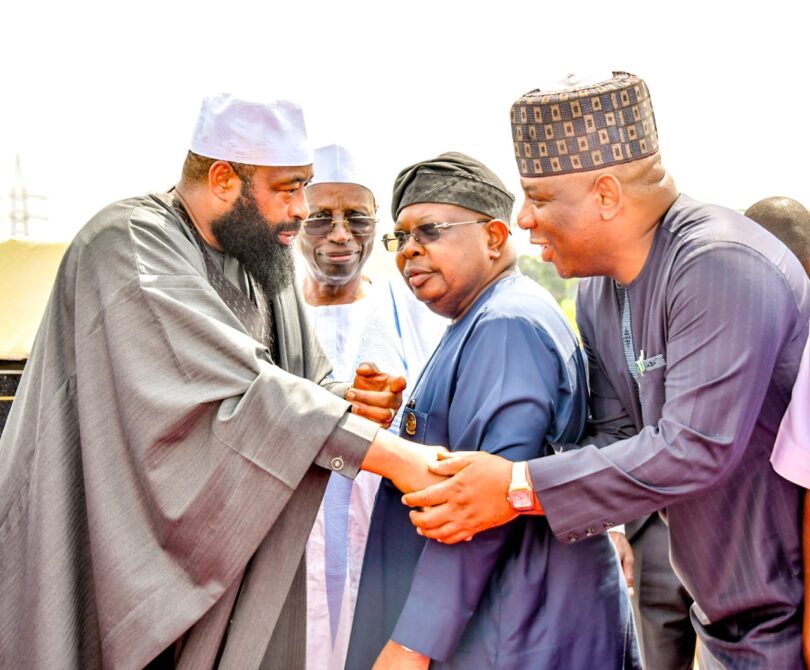
The ground-breaking ceremony was attended by Minister of Power, Joseph Tegbe, Minister of Steel Development, Prince Shuaibu Audu; Minister of State for Industry, Senator John Owan Enoh; Niger State Governor Mohammed Umaru Bago and top executives of the African Industries Group.
While commending the state governor for the feat, the CEO/ Chairman Niger State Electricity Regulatory Commission (NSERC), Engr. Mohammed Sharu assured that the Commission will ensure it regulates electricity generation, distribution, supply, and related market activities within Niger State.
According to Sharu “the establishment of the NSERC marks an important milestone in Niger State’s transition towards a transparent and sustainable electricity sector. We will focus on governance systems, regulatory continuity and consumer protection for efficient, safe, reliable and sustainable electricity supply in Niger State”.



Leave a Comment