By: Our Correspondent
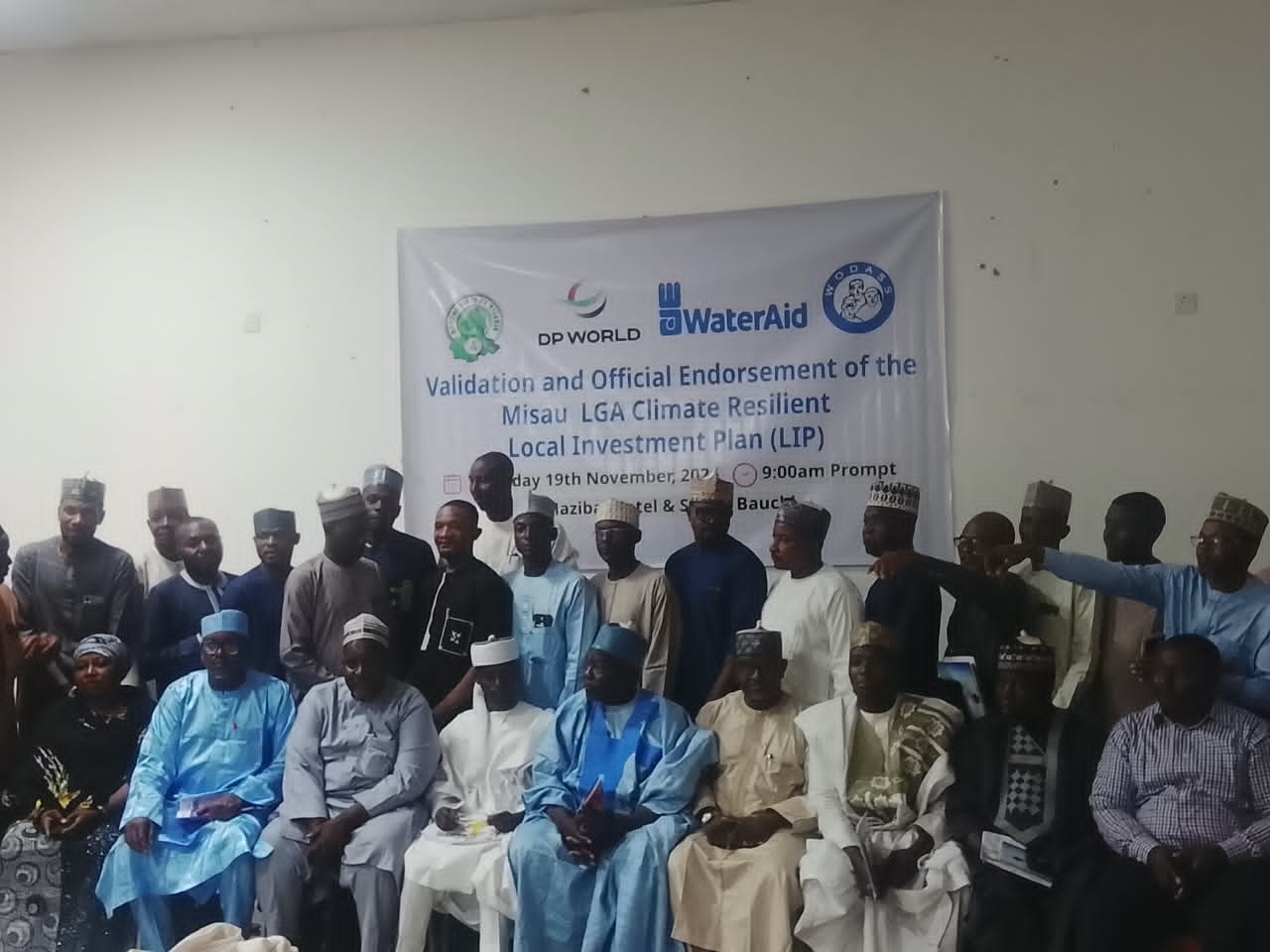
Stakeholders in the water, sanitation and hygiene (WASH) sector in Bauchi State, have validated the Climate-Resilient WASH Investment Plan for Misau Local Government Area.
The Climate-Resilient WASH Investment Plan, is expected to provide a framework for identifying investment priorities, resources mobilization and coordinating interventions to improve sustainable WASH services in Misau.
Speaking at the exercise on Thursday, Mr Mashat Mallo, State Programme Lead, Water-Aid, Bauchi, described the validation as a major step towards improving WASH service delivery in the local government.
Mallo said, Misau local government area has been the Water-Aid’s focal local government, for implementing its 2023–2028 strategy.
He said that the organization, is supporting the local government to develop effective plans for WASH service delivery, including capital investments, maintenance and operational costs.
According to him, the investment plan was developed through a life-cycle costing process, to identify the resources required to sustain WASH services.
He described the validation exercise as successful, noting that stakeholders identified some areas requiring corrections and updates.
“The document was validated, subject to the necessary adjustments by a technical team, before its final endorsement by the local government chairman.
“The investment plan will guide resource mobilisation, coordination and alignment amongst stakeholders, as well as promote the sustainability of WASH investments,” he said.
He thus advocated for full utilization of the document, adding that it serves as a practical guide for WASH service delivery.
He said that government agencies, development partners, philanthropists and other investors, should use the document to identify communities with the greatest needs.
“This will ensure that investments addresses the actual priorities of the local government,” he added.
Also speaking, Dr. Sanusi Waziri, Bauchi’s Statistician-General, Bauchi State Bureau of Statistics, said that the validation exercise identified gaps in some of the data used in developing the investment plan.
Waziri said, the population figures, number of functional facilities and status of water points, required further verification and updating.
He explained that accurate population data and reliable information on functional and non-functional water facilities, were essential for effective planning and policy formulation.
He stressed that government interventions must be guided by credible data, to ensure that resources were allocated according to the actual needs of communities.
The statistician-general said, stakeholders adopted and validated the document subject to corrections, describing the process as an opportunity for participants to agree on issues and address disagreements.
On sustainability, Waziri called for stronger community ownership and protection of public water facilities.
“Communities as primary beneficiaries, must take responsibility for safeguarding water infrastructure, against vandalism and other forms of misuse.
” Local governments should strengthen monitoring and protection mechanisms, to prevent the destruction and unlawful disposal of public water facilities,” he added.
Waziri called for increased private-sector participation in WASH service delivery, noting that government alone cannot meet the growing demand for water infrastructure.
He advocated for investments in boreholes, rainwater harvesting, earth dams and water treatment plants to improve access to safe and affordable water.
Waziri further said that the growing cost of household water supply, has made investment in sustainable water infrastructure imperative.
The statistician-general thus emphasised that access to quality water, will improve public health, living standards and economic activities.
He urged government and private investors, to explore opportunities in the water sector, to address existing gaps and improve service delivery