

By: Monday Danladi, Bauchi
The National Human Rights Commission (NHRC), has called for inputs from stakeholders on how to effectively implement the National Action Plan (NAP) for the protection and promoting human rights and dignity in Nigeria.
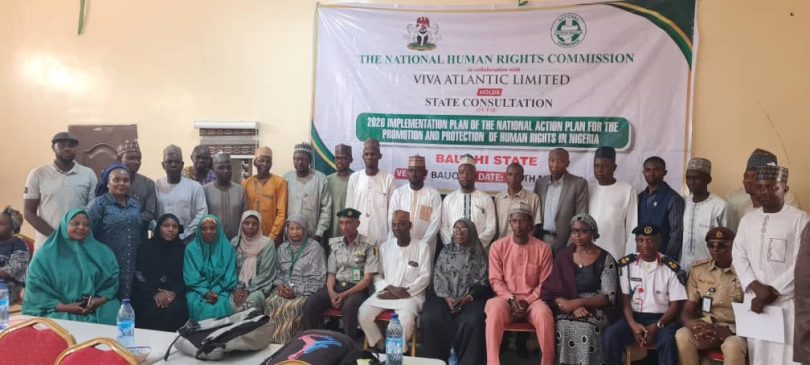
The Commission consequently, on Tuesday, in collaboration with the VIVA Atlantic Limited, organised a one-day State Consultative meeting on the 2026 Implementation Plan of the National Action Plan (NAP), for the promotion and protection of Human Rights in Nigeria.
In his opening remarks at the meeting held in Bauchi, the Executive Secretary of the National Human Rights Commission (NHRC), Dr. Tony Ojukwu, SAN, stated that, “The National Action Plan (NAP) is a guiding document for the promotion and protection of human rights in Nigeria in line with the Vienna Declaration and Programme of Action adopted at the World Conference on Human Rights in Vienna, Austria in 1993.”
According to him,”This document represents a collective commitment by government institutions and Non-State Actors to address existing gaps, respond to emerging challenges, and build a more inclusive and rights-respecting society.”
He stated that, “According to the Honourable Attorney-General of the Federation and Minister of Justice in the preface to the National Action Plan for the Promotion and Protection of Human Rights in Nigeria (2024 -2028) “reinforces the commitment of the present administration in particular, and the government of the Federal Republic of Nigeria, in general, to the promotion and protection of all human rights as guaranteed by the Universal Declaration of Human Rights and other international and regional instrument to which Nigeria is part, as well as the Constitution of the Federal Republic of Nigeria”
Represented by the Bauchi State Coordinator of NHRC, Barr Yahcit Dala, the NHRC ES stated that, “In line with this declaration, Nigeria adopted its first National Action Plan for the Promotion and Protection of Human Rights (2009–2013), serving as a framework to implement Nigeria’s international human rights commitments and guide coordinated action across government institutions.”
He added that,”Following the expiration of the NAP 2009–2013 plan, the National Human Rights Commission championed and led a decade-long consultative process involving a wide range of stakeholders. This process cut across multiple stages, including consultations with Ministries, Departments and Agencies (MDAs), Civil Society participation, as well as deliberations by steering and coordinating committees.”
He added that,”The extensive and inclusive nature of this process ultimately culminated in the adoption of the National Action Plan (2024–2028), reflecting a renewed and more comprehensive commitment to the promotion and protection of human rights in Nigeria.”
“Consequently, the NAP (2024 – 2028)is now firmly within its implementation cycle. It has become important to monitor and evaluate implementation activities across agencies, by identifying operational challenges, and strengthening implementation strategies where necessary,” he added.
Tony Ojukwu further stated that, “In this regard, the National Human Rights Commission as the coordinating and oversight body for the implementation of NAP, deems it necessary to convene a State Consultative forum with relevant stakeholders.”
According to him, “This forum will provide us with the platform to discuss modalities, clarify roles and responsibilities, harmonize efforts across sectors, and address emerging gaps. More importantly, it will also allow us to strengthen synergy between Ministries, Departments and Agencies (MDAs) and Civil Society Organizations (CSOs), recognizing that sustainable human rights protection can only be achieved through coordinated and inclusive action.”
He concluded, “As we deliberate, I encourage us all to engage constructively, to share insights from our respective experiences, and to propose actionable recommendations that will move us closer to achieve the objectives of the National Action Plan (2024 – 2028).”.
In his remarks, Bauchi State Commissioner for information and Communications, Usman Shehu Usman, said that, “I’m delighted to be in this gathering. I came purposefully because of the respect I have for the National Human Rights Commission. I was one of the people when Human Rights Commission was about to launch in Abuja, especially in the year 2000, when Human Rights Commission was just a human rights commission, but people don’t see the action.”
“So, that is why when I received this invitation, despite the fact that we have a function going on, I said I will come even if it is just a minute for me to say the respect of Human Rights Commission, because for a democracy to be sustained, we have to have such Commission,” he added.
According to him,”In every society, in every democracy, it’s not only for peace, but good governance when you have a very strong civil society. The issue of human rights violations in this country, if we start naming it, it starts right from our home, our compound, our houses. The violations are so diverse and we have to do a lot to enlighten people.”
He stressed, “I will just say, just yesterday, when I was riding to the Government House, I saw a car carrying a cow. One of the cows was tied, the rope is already in the eye, just direct in the eye, the cow was just struggling. I had to stop the car, they don’t see the see the need to care for it, a man was just next to the cow, he don’t care because that is not a human being. That’s not a child that will be crying. So he immediately removed it, and the cow just turned its head like this from relief.”
The Commissioner added that, “We have a lot of domestic violence. We have a lot of serious, serious problems that are going on that the Human Rights Commission needs to work on. But some of them, I think, our laws need to be changed.”
He added, “I’ll give example. Some of you may have known a child that his eyes was removed. The First Lady of the State took the matter to the court. The boy is still under her custody, taking care of him. But the court has released him as we speak. Nothing has been done to him. What can the Police do? Nothing. Because the Judge has already released him. So there are a lot of small cases and big cases that I think we need collectively to tell ourselves that personally, this is, for me, is against human rights. I feel it emotionally, this is not possible.”
Usman Shehu Usman added that, “So, I think we have a role to play, all of us, because these are things that happen, like I said, from our homes. If you see the child labor we are having in this country due to poverty and so on, these are serious issues that we need to take. You see a small child doing a job that somebody of 30, 40 years has to do. But you have no right to say anything because this is where he lives. This is what he does for his family.”
He added that,”If you look at girls that are sent for domestic work, especially in privileged people’s homes, their parents bring these children. And the labor is beyond their capacity, but we still allow it because, this is what the people want, this is how they live. So we need a lot of awareness.”
“I’m so happy that the Human Rights Commission is here and our Ministry of Information and Communication will be part of this forum. We are sending our Desk officer who will be with them all the time and we will use our media. As most of you know, we have the largest community radio in Nigeria and this will be used to disseminate any program that is brought by this forum. Our office is open all the time. Whatever cooperation, whatever issues that the Commission brings and the forum, that is why the Director of Information will always be with you,” he concluded.
Participants were drawn from relevant MDAs, CSOs working on human rights, stakeholders and Journalists.
End
Photo attachment: 1000217340.jpg
Photo attachment: 1000217343.jpg
A cross section of participants at the meeting.
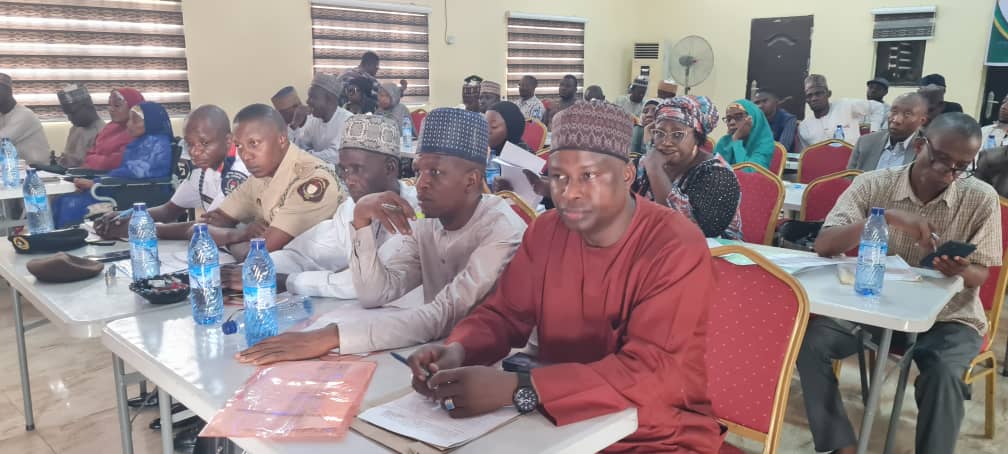
A cross section of participants at the meeting



Leave a Comment