By: Monday Danladi, Bauchi
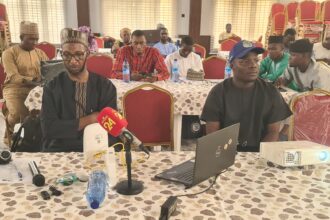
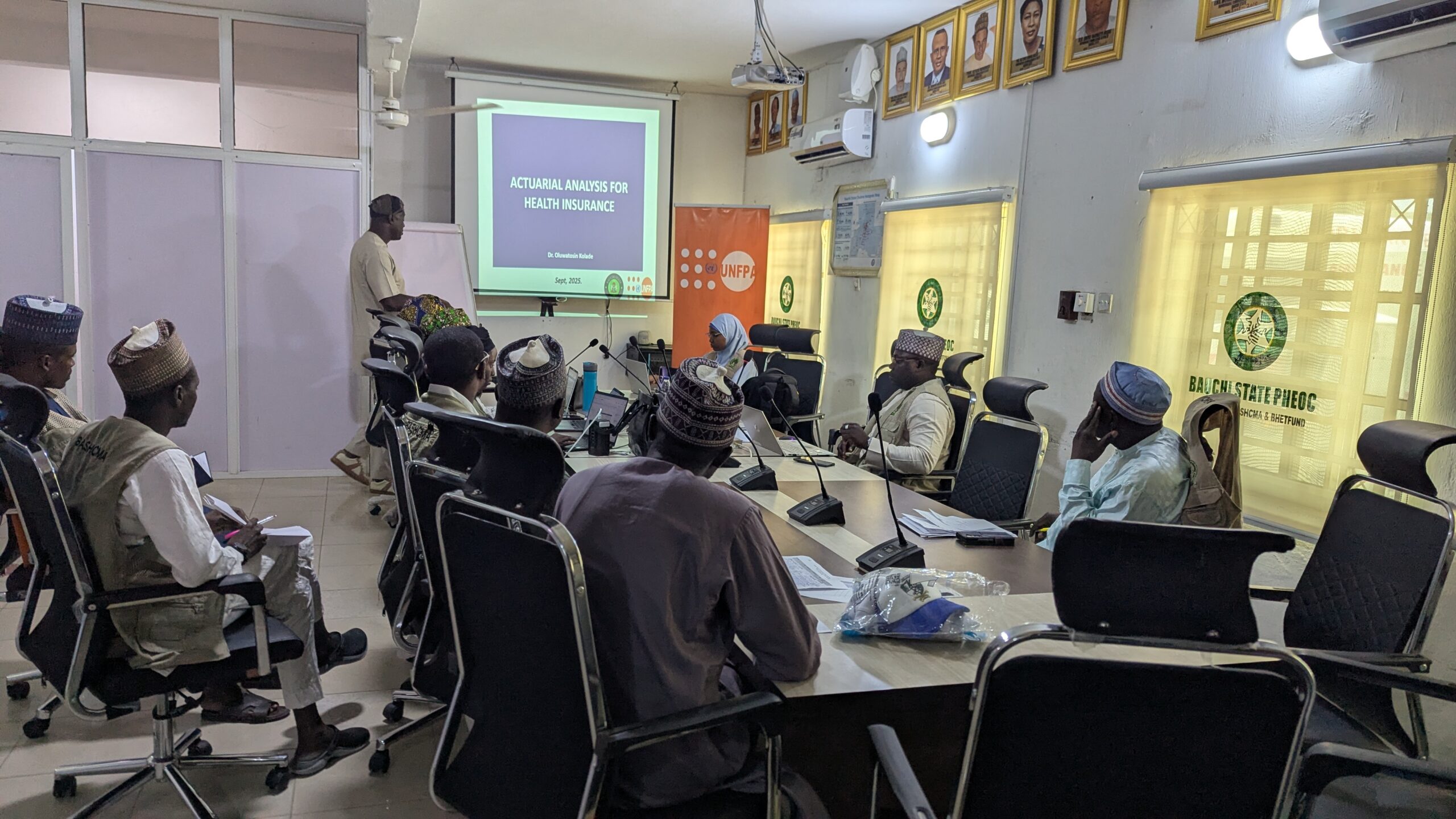
The United Nations Population Fund (UNFPA) in collaboration with the Bauchi State Ministry of Health and Social Welfare as well as the State Health Contributory Management Agency (BASCHMA), has organised a 3-day Pre-Actuarial/Health Financing 101 Capacity Building Workshop for personnel of all health sector agencies with the aim of strengthening effective and efficient services delivery in the sector.
Facilitating the workshop at the EOC, Ministry of Health and Social Welfare, Bauchi, Dr. Oluwatosin Kolade, the Sexual Reproductive Health and Health Systems Strengthening Specialist at UNFPA Country Office, said, “We are here in Bauchi for the health financing and pre-actuarial analysis workshop, it’s an initiative of UNFPA as a way of supporting some of the reforms within the country’s health sector, particularly around universal health coverage (UHC).”
He added that, “Towards the country’s journey for universal health coverage, going by the National Health Act 2014, health insurance was decentralized and so gave birth to the state social health insurance agencies, who now serve as the boots on ground across the 36 plus One states. These 36 plus one states actually have their own schemes, of course with their benefit packages.”
Oluwatosin Kolade added, “Going by UNFPA’s transformative agenda of zero tolerance to unmet needs for family planning and also ending avoidable maternal deaths, this concept was actually born to see how to sustainably finance family planning and other high interventions, low impact services, integrating it into the benefit package of the state social health insurance agencies.”
“We see that as one of the sustainable mechanisms that we can use to actually ensure the availability of such high-impact services. And so we thought that understanding that actuarial analysis is a multi-specialty, very complex study, we thought to use this opportunity to do some form of refreshers with the relevant state actors within the State Ministry of Health and its relevant agencies,” he added.
The UNFPA Official added, “So by building their capacity on things around the health system building block, using the WHO framework, and also the keys on health financing, looking at the core functions, as well as deep diving into strategic purchasing, which is our core way of purchasing by the states.”
He added, “And of course, snowball into the bits on the actuarial analysis, for it to serve as a foundation for the actuarial analysis work that UNFPA is supporting the state with. The novel thing that UNFPA is doing with this actuarial analysis work is we’re being creative about it in such a way with the sustainability lens, so that we leave behind a costing model that can be used subsequently for such tasks.”
“However, one of the key sustainable ways we do is today we’ll be inaugurating what we have as the Bauchi State Actuarial Analysis Committee that will work with the actuarial analysis entity that has been engaged by UNFPA, so that they handhold them through the process, so that they understand what data collection, what type of data sets are used for this kind of task, as well as how you actually provide for issues of data gaps, right,” he stressed.
According to him, “And also then snowball into them understanding the costing model that is to be developed and left behind. That way we have a number of people within the state who are able to then carry on the activity going forward, and so that’s the whole idea of this three-day engagement.”
On what impact the training is going to add to what already UNFPA is doing in Bauchi State, he said, “In fact, this is like layering on what we’ve been doing in Bauchi State. This has actually brought together virtually all relevant stakeholders within the Ministry of Health. What it has actually done for UNFPA, it has actually helped in advancing one of its key mandates, because there’s a connection between the first mandate and the second one. That is by advancing the agenda of family planning, which we have been seeing as a silver bullet with the highest return on investment when we talk about issues on maternal and newborn mortalities, right.”
He added, “And so, that connection between the first two of the transformative agenda, actually this helps in advancing this to a very large extent. And understanding that Nigeria’s decision on the journey for UHC is really on using insurance. So this is UNFPA aligning with this and also advancing, supporting with advancing Nigeria’s journey towards universal health coverage.”
He added, “And so for us, it’s a delight for us. I must tell you that the participants at this three days have been from the State Ministry of Health, from the Bauchi State Health Contributory Management Agency, from the Bauchi State Primary Healthcare Development Agency, as well as the State Hospital Management Board and also the Tertiary Specialist Hospital. So you have a cross-pollination of those from the demand side and those from the supply side. And it’s really been very, very engaging and, in fact, very interesting, to the extent that part of our core objective was also to use this as an opportunity to address some operational issues.”
According to him,”The BASCHMA has been operational for about four to five years. It has given us an opportunity to step back and see how well have we done with our implementation, and also giving the opportunity for those on the supply side to say, how do we fine-tune things? In fact, one of the outputs of yesterday, which we’re very happy with, there’s been some long-lasting issues, lingering issues within the stakeholders.”
He explained that,”Based on the session on strategic purchasing, it birthed some co-created solutions. So it wasn’t a case of UNFPA coming to be prescriptive on what to do, but a case of the solution actually came from within the stakeholders, based on the refresher on the capacity that they have been able to build. And this is what we aim to continue seeing as we leave behind this within BASCHMA, and of course as we move into the core actuarial analysis bit of work. And for UNFPA, it’s a continuous partnership, and so we’re happy to have contributed in part of this.”
Oluwatosin Kolade added that, “However, this has actually shown some improvement in the status of what has been in Bauchi State. I’ve seen very dedicated state actors. In fact, it would be dishonest not to mention that we also had in attendance the Chairman House Committee on Health from the Bauchi State House of Assembly, and he’s been very dedicated to these three days, coming in, sitting in, except for when he had his official assignment to do, and he made informed inputs.”
He stressed, “So you’ve seen a set of dedicated, willing, trainable, as well as committed state actors in Bauchi State. And nothing gladdens one’s mind than that, to see that you’re not just doing this as a tick-the-box affair, but it’s a collaboration, and we see that this will definitely, would have leave virtually all of us within the state.”
He further said, “Well, interestingly, I’ll be very happy to mention this. You see, where you need to do this kind of support, one critical thing in the journey of mainstreaming services into benefit package like this is political will. Because you’ll be having engagement with stakeholders. Part of the journey is the stakeholder engagement, which is for the entirety of the integration agenda.”
He commended the political will from the government saying it has been consistent and aided the workshop, stressing,”In fact, UNFPA had options of two states of all the 14, but we have actually done in four.”
According to him, “So the remaining 10 states where we have our footprints. But in terms of our family planning footprint, is the 36 plus one. So we had options from about 26 states who to actually provide based on funding. We understand what the funding landscape looks like now.”
He added, “Based on the parameters, Bauchi State government has consistently supported the GCC. And that was a major criteria that was considered by UNFPA, because that shows political will.”
He emphasised, “And so, that political will actually earned Bauchi to be top two to be considered for this. And so it was an end support and not just a forceful one. And interestingly, it also came at the right time, because the stakeholders had actually been looking for the opportunity for this kind of support, because integrating a service is not just by lip service, it’s not just by word of mouth.”
According to him,”There’s a science to it. And so this bit of the science called the actuarial analysis, is quite expensive and is a super specialty thing. So we can understand when governments are not able to fully finance it themselves.”
He concluded, “So UNFPA came to that and said this is our way of supporting them to ensure that this is actualized. And the least we can say is we want more of that level of political will.”