
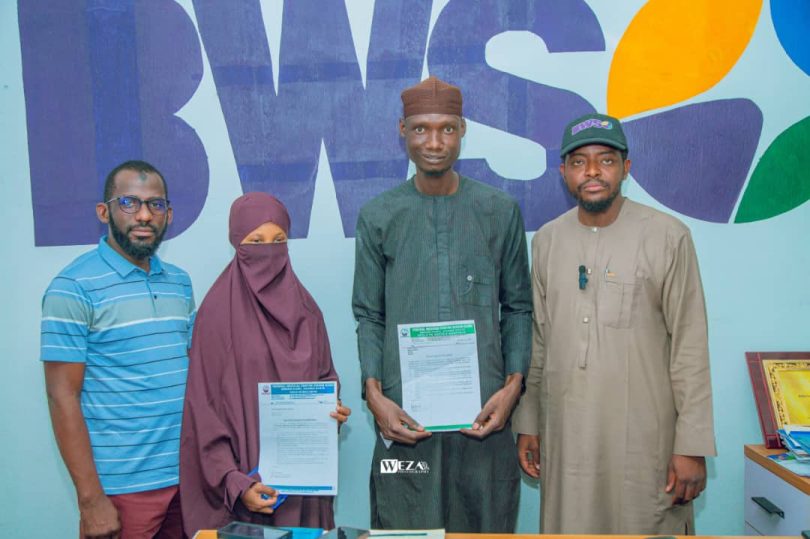

In a political environment often defined by short-term gestures and patronage-driven interventions, Dr. Bala Maijama’a Wunti is charting a different course — one that prioritises sustainability, dignity, and long-term impact in youth empowerment. His recent facilitation of employment opportunities for young people from Bauchi State is not merely an act of goodwill; it signals a broader shift in how leadership can address unemployment by investing in human capital rather than dispensing temporary relief.
The employment of three Bauchi indigenes at the Federal Medical Centre in Birnin Kudu reflects a model that moves beyond conventional political charity. Rather than distributing handouts or seasonal incentives, Dr. Wunti’s approach focuses on integrating young people into structured professional environments where they can build careers, acquire skills, and contribute meaningfully to society. It is a subtle but powerful departure from the norm — one that places responsibility and opportunity side by side.
At the heart of this effort is the Bala Wunti Support Organisation (BWSO), a youth-driven, independent platform committed to leadership development, capacity-building, and social transformation. Though inspired by the values of Dr. Wunti, BWSO operates outside the sphere of electoral politics, positioning itself instead as a vehicle for nurturing a new generation of leaders grounded in service, integrity, and competence. This distinction is critical in understanding the long-term vision behind the initiative.
Representing this vision on the ground, Muktar Ahmad Jarmajo, Chief Executive Officer of BWSO, emphasised that employment is only one layer of a broader developmental philosophy. According to him, true empowerment lies in equipping young people with the tools, mindset, and ethical foundation necessary to navigate complex societal challenges. Jobs, in this context, are not endpoints — they are entry points into a lifetime of productivity and leadership.
This evolving model reflects a growing recognition that unemployment cannot be solved through isolated interventions. Instead, it requires deliberate systems that connect education, mentorship, and opportunity. Dr. Wunti’s strategy aligns with this thinking by combining job facilitation with ongoing engagement, ensuring that beneficiaries are not only employed but also supported in their personal and professional growth.
Equally significant is the moral dimension embedded in this approach. Beneficiaries are encouraged to see their employment not just as personal success but as a collective responsibility. They are expected to uphold professionalism, demonstrate integrity, and serve as role models within their communities. This emphasis on values helps to shift the narrative from individual gain to societal contribution — a perspective often missing in traditional empowerment schemes.
Beyond individual success stories, BWSO is building a structured ecosystem to sustain these efforts. Through the appointment of coordinators across local governments and zones, the organisation is creating a grassroots network capable of identifying talent, mobilising young people, and delivering programmes tailored to community needs. This decentralised model ensures that empowerment is not concentrated in urban centres alone but reaches diverse populations across Bauchi State.
As articulated by the organisation’s Chief Communication Officer, Abubakar Al-Sadique, this expansion represents a transition from vision to implementation. The coordinators serve as operational anchors, translating ideals into tangible outcomes through community engagement, mentorship initiatives, and capacity-building programmes. In doing so, they reinforce the idea that leadership development must be intentional, structured, and inclusive.
What distinguishes this model from many political interventions is its emphasis on continuity. While political cycles often disrupt development programmes, BWSO’s institutional framework is designed to endure beyond electoral timelines. By focusing on systems, values, and people, the organisation is cultivating a pipeline of leaders who can sustain progress irrespective of changing political dynamics.
Dr. Bala Wunti’s efforts ultimately challenge a deeply rooted assumption—that political influence must be exercised through visibility and immediate gratification. Instead, his approach demonstrates that quiet, strategic investments in people can yield more profound and lasting results. It is a model that prioritises substance over spectacle, replacing transactional politics with transformational leadership.
In a time when many young Nigerians are searching for credible pathways to success, this shift in narrative offers a compelling alternative. By linking employment to mentorship, and empowerment to responsibility, Dr. Bala Wunti and BWSO are not just creating jobs — they are shaping a generation. And in doing so, they are redefining what it means to lead in a way that is both impactful and enduring.
Abubakar Al-Sadique Chief Communication Officer, BWSO 20/03/2026





Leave a Comment