

By: Adelowo Oladipo, Minna
The National Emergency Management Agency (NEMA) and other stakeholders in disaster management in Niger state, have pledged to strengthen coordination mechanisms, improve preparedness and upgrade early warning systems as part of measures to mitigate disasters in 2026.
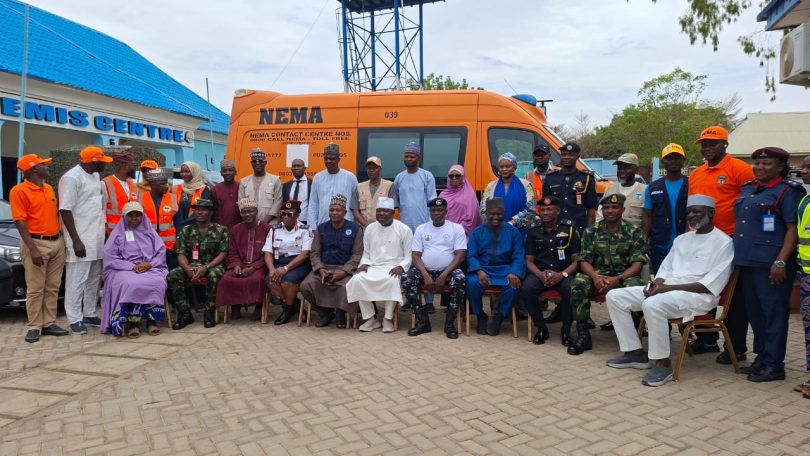
The resolution was reached at a stakeholders meeting organised by the National Emergency Management Agency (NEMA) to review 2025 disaster management activities and strategies for 2026 on Tuesday, 31st March, 2026 in Minna , Niger State Capital by by.
The meeting, themed “Building Synergy for Effective Emergency Response: A Multi-Agency Review of Niger State 2025 Disaster Management Activities and Strategic Preparedness for 2026,” brought together key actors in emergency response.
In his opening remarks, Mr Hussaini Isah m, Head, NEMA Minna Operations Office, said stakeholders had deliberated extensively and resolved to improve coordination, preparedness and leadership attitude in disaster management.
Isah, who oversees NEMA operations in Niger and Kwara states, said outcomes of the meeting would guide planning for 2026.
He commended stakeholders for their swift responses to disasters in 2025, noting that successes recorded were due to strong collaboration, coordination, partnership and leadership.
According to him, the meeting was convened to review activities for 2025 and improve response capacity, preparedness and mitigation strategies.
He noted that over 3,000 deaths recorded in 2025 resulted from multiple disasters, underscoring the need for improved synergy among stakeholders.
“On behalf of the Director-General of NEMA, Mrs Zubaida Umar, I welcome you to this important meeting to review our disaster management activities and collectively strategise for a more proactive approach in 2026.
“The successes we recorded were not incidental but a direct result of our strong partnership and synergy,” he said.
Isah recalled that 2025 witnessed various challenges, including flooding, fire outbreaks and communal incidents, which tested stakeholders’ preparedness and response capacity.
He, however, said collective efforts helped to save lives, protect livelihoods and deliver timely humanitarian assistance to affected communities.
He described the meeting as an opportunity to assess performance, identify gaps, share lessons learned and strengthen coordination mechanisms.
“As we look ahead to 2026, emphasis must be placed on early warning systems, community engagement, risk reduction strategies and capacity building,” he said.
In a goodwill message, Alhaji Abdullahi Baba-Arah, Director General of Niger State Emergency Management Agency (NSEMA),
described NEMA as a reliable partner supporting the state during emergencies.
Baba-Arah, represented by Alhaji Garba Salihu, Director, Planning and Special Duties in NSEMA, said the state experienced significant disaster challenges in 2025 and stressed the need to review strategies, identify gaps and renew partnerships for improved response.
Salihu commended NEMA for timely interventions, particularly during the Diko tanker explosion and Mokwa flood incidents.
Also speaking Dr. Ahmed Ibrahim Inga, Commissioner, Niger State Ministry of Humanitarian and Disaster Management, said disaster management was a collective responsibility.
He reaffirmed the ministry’s commitment to providing humanitarian support to disaster victims and stakeholders to work together in developing a roadmap for improved outcomes and encouraged active participation in discussions.
In her presentation, Dr Zainab Ndanusa, Head of Disaster Risk Reduction Unit, NEMA. said most disasters shared common triggers, including natural factors and gaps in preparedness and response.
She noted that stakeholders actions could either enhance or undermine humanitarian outcomes and called for critical review and practical recommendations.
Ndanusa, who also presented statistics of major disaster incidents in 2025, said the Mokwa flood claimed 162 lives, with 13 injured and 83 persons missing, while 1,590 persons were displaced.
She added that the Borgu boat mishap recorded 29 deaths, 50 injuries,and two missing persons, while the Katcha tanker explosion resulted in 45 deaths and 63 injuries.
According to her, the Diko tanker explosion claimed 86 lives, with 55 people injured.
She outlined key strategies for 2026 to include strengthening preparedness, enhancing stockpile logistics, improving response capacity, upgrading early warning systems, improving communication and data sharing, as well as conducting regular multi-agency drills.
In his remarks, the Chairman of the Niger State Universal Basic Education Board (NSUBEB) and former Controller-General of the Federal Fire Service, stressed the importance of rapid response in disaster situations.
He urged stakeholders to adopt effective and responsible approaches to managing disasters in the state.
Stakeholders at the meeting included officials from NSEMA, Nigerian Red Cross, Nigeria Security and Civil Defence Corps (NSCDC), Nigerian Air Force, Federal Fire Service, National Inland Waterways Authority (NIWA), National Orientation Agency (NOA) and the Nigerian Army.



Leave a Comment