
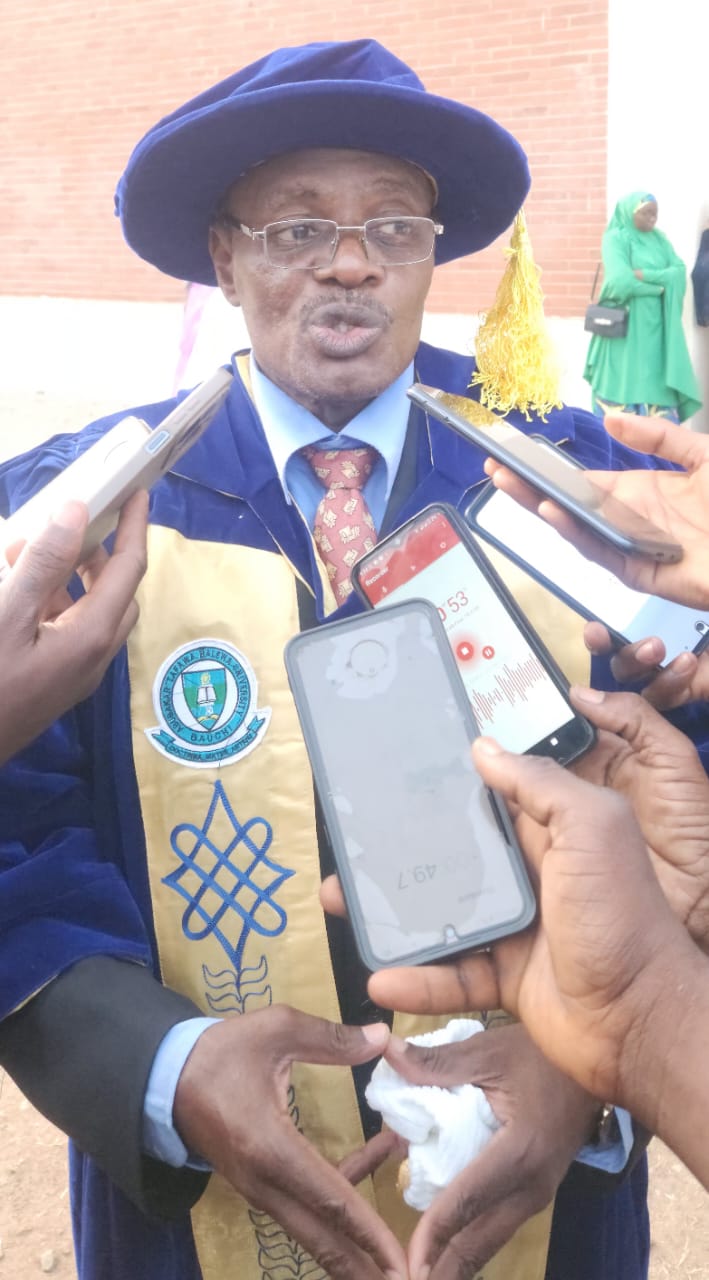

By: Monday Danladi, Bauchi
Abubakar Tafawa Balewa University (ATBU), Bauchi, Tuesday, held its 46th inaugural lecture series titled “A Disaggregated Approach to Ceramics, Raw Materials, Beneficiation, and its Socio-economic Impact in Nigeria,”
The lecture, was delivered by Professor Abdullahi Adinoyi Umar, of the Department of Industrial Design, Faculty of Environmental Technology of the University.
In his presentation, the Lecturer compared Nigeria’s growing population with a global average of about 26% stating that, “This youthful population structure presents both a significant challenge and a latent opportunity for development.”
He stated that, “According to the National Bureau of Statistics (NBS), as at the fourth quarter of 2020, approximately 13.9 million Nigerian youths were unemployed, while about 40 million were classified as eligible to work. Of this number, only 14.7 million were fully employed, underscoring the severity of Youths unemployment and underemployment in the country.”
The Don added that in response to this challenge, the Federal Government of Nigeria (FGN) has introduced several stop-gap and structural measures aimed at mitigating youths unemployment.
Abdullah Umaru explained that, One such interventions was the establishment of the National Directorate for Employment (NDE) in 1986. By Decree No. 34 of 1989, the NDE was mandated, among other responsibilities, to design and implement programmes to combat mass unemployment and to formulate policies for the development of labour-intensive work programmes.
Its core objectives include unemployment reduction, skills acquisition, entrepreneurship development, poverty reduction, and the improvement of the financial well-being of citizens.
Over the years, scholars and policy experts have been engaged in proposing solutions to both longstanding and emerging socio-economic challenges. These interventions have been approached from diverse perspectives, including food security, energy, industrial production, healthcare delivery, and related sectors.
“My concern, as an Industrial Designer, is to interrogate the issues of decent work and economic growth within the context of production and manufacturing systems, and to explore how these can be leveraged to address youth unemployment,” he added.
He stressed that,”Interestingly, two of the last three Distinguished Inaugural Lectures in the ATBU Inaugural Lecture Series were delivered by scholars from the Faculty of Engineering. As the 46th Distinguished Inaugural Lecturer, I join this discourse to reflect on issues of production, manufacturing, and their nexus with job creation and youth engagement, from the standpoint of industrial design.”
According to him,”Industrial Design (ID) is a systematic design process applied to products intended for mass production. It involves the creative and strategic determination of a product’s form, features, reflect on issues of production.
He added that Industrial design focuses on aesthetic quality, usability, and manufacturability to meet both user needs and requirements (Wikipedia, 2024).
He stated that the emergence of industrial design can be traced to around 1760, when increasing demand for a transition from craft-based production to mechanized manufacturing processes.
According to him, industrial design were introduced to complement human labor, marking a period of transformation which shift created the need for systematic planning and products suitable for large-scale production (Heskett, 1980; Forty, 1986).
The lecturer therefore recommended that a private-sector-driven programme be initiated in partnership with the National Directorate of Employment (NDE) to establish centres and clusters for the processing of industrial minerals near their extraction sites.
He added that each centre would focus on one of approximately ten identified minerals, engaging 100 youths per centre. Ten centres would form a cluster. Across Nigeria’s 774 local government areas (LGAs), this approach could potentially engage 7,740,000 youth (100 x 10 x 10 x 774), with LGAs rich in mineral endowments
potentially supporting additional centres.
He further recommended that the Central Bank of Nigeria (CBN) introduce a funding arrangement for the processing sector, modeled on the Anchor Borrowers Programme, to facilitate access to loans and capital for the programme initiated in partnership with Machinery development should focus on easy-to-operate, low-tech equipment suitable for
processing activities.
“To this end, PRODA’s mandate and operations should be expanded to allow accelerated production of prototypes tailored for the extractive industry, and to open branches in all states of the Federation,” he added.
He further recommended that Support should also be provided for private-sector interventions in off-grid power generation, which would not only supply the centres and clusters with electricity but also create additional employment opportunities.
Operators of the centres and clusters should receive comprehensive training to equip them with both technical and managerial skills, ensuring efficiency and sustainability.
The curriculum for ceramics design and technology in Nigerian universities and Polytechnic should be reviewed and updated to include aspects of ceramics materials processing, aligning education with industry needs.
Government should implement attractive incentives to encourage the return of large-scale ceramics industries and the reopening of moribund plants.
Such incentives could include tax breaks and reduced import duties for heavy production equipment. but also create additional comprehensive training to equip Nigerian Universities and Polytechnics.
He added that researchers are encouraged to pursue interdisciplinary collaboration for improved outcomes, ceramists working alongside mechanical engineers, chemical engineers, chemists, and sketers to optimize processes and market strategies.
Furthermore, it is recommended that a National Council on Ceramics (NCCER) be established out from the Raw Materials Research and Development Council (RMRDC), with a bust mandate to oversee policy, research, and production in the ceramics sector, given it’s significant potential for revenue generation and job creation.
According to him, since 1950, when Nigeria joined the ceramics revolution, much has happened, Ceramics as a subject has gradually been integrated into the curricula of higher institutions, stimulating research into the nature of materials and optimal production methods.
According to him, “Because of its wide range of applications, ceramics is now being approached by professionals from various disciplines. Geologists, chemists, chemical engineers, and mechanical engineers are all conducting research in the field, leading to a convergence of ideas and interdisciplinary collaboration.”
He stressed that, “As an Academic, I often pause to wonder what will become of my profession 600 years from now. How will it evolve? How will inevitable societal and technological changes affect it? To find clues, I turn to history. I recall the role of China in advancing knowledge of ceramics: the chemistry behind porcelain, the engineering innovations that supported it, and the development 100 years ago.”
“Today, ceramics of high-temperature kilns all occurring approximately 1,000.
research continues to advance and accelerate at a phenomenal pace. As hydrocarbons are depleted and humanity turns to renewable energy sources, and as forests and wildlife (if not extinct) are increasingly protected, research into harnessing solar energy will take center stage,” he added.
According to him,”Humans will rely on the most abundant natural resources: the earth, the sun, and water. By combining solar power (the sun) with earth-derived materials (SiAl) and water (H2O) the most common materials on the planet ceramics will play a central role in fulfilling humanity’s needs for transportation, shelter, sanitation, and communication.”
In a stirring speech by the Vice Chancellor, Professor Ibrahim Hassa Garba, he charged academics to redouble efforts towards achieving excellence in research and community service.
The Vice Chancellor lamented the long hiatus in the University’s Inaugural lecture series, but expressed optimism that the tide was being turned.
“The zeal to uphold this academic culture has eluded us for a long time, while lectures are held only sporadically and not sequentially. The time to bring it to life is now,” he said.
The Vice Chancellor announced that the University was re-engaging with global University rankings, with impressive preliminary results, and urged Professors to take advantage of the platform to showcase their research and academic prowess.
Professor Abdullahi Umar, the inaugural lecturer, was lauded for volunteering to kick-start the series under Professor Ibrahim’s stewardship.
The Vice Chancellor urged other professors to follow suit, assuring them of full support from the university administration.






Leave a Comment